Wednesday, October 22, 2014

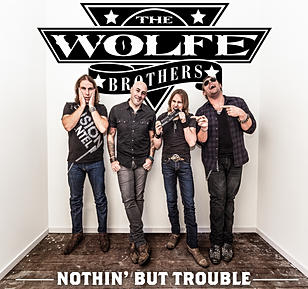
Interview: Tom Wolfe of the Wolfe Brothers

Even though it seems like the Wolfe Brothers have been touring nonstop all year (mostly with Lee Kernaghan) they found the time to record a new album, Nothin' But Trouble, and then they got straight back on the road. Even if country rock isn't your thing, the Wolfe Brothers are definitely worth your time - they are  a fantastic live act who have managed to capture that live sound on their new album. Plus they're great guys. I spoke to one of those great guys, Tom Wolfe, recently.

So, Tom, it’s always a pleasure to support the Wolfe Brothers, I think you guys are terrific. But one thing I don’t think you are is trouble.  And I know the album title is Nothin’ But Trouble, but I don’t buy it because you guys work pretty hard and you’re very professional.  So is it a little bit of smoke and mirrors, that title?
It is a little bit of smoke and mirrors.  No, look, it’s all a bit of tongue in cheek. The song is a true story and it’s just about the first cars we’ve owned and some of the girls we’ve met over the years, you know, and it’s just a bit of funk and soul.  And then we’ve thought that’s a great album title, you know, we thought that’ll turn a few heads and get people talking and people will be doing just that [laughter].

Well, exactly, because it made me immediately think that doesn’t really fit with anything I know about these guys [laughs].
Exactly, exactly.  No, it’s great, we’re really happy with it.

Now, I know that the relationship with [album producer] Luke Wooten goes back a few months before you actually recorded with him, because I remember talking to Brodie and he said you’d been in Nashville and met him there. So Luke came out here to record with you?  Because I know the first album was done either in your living room or Nick’s living room.
Yeah, we did it in my bedroom.

So how did you find the conventional recording process this time?
Oh, look, they were probably some of the best weeks of my life.  We lived in the house next to the studio, there was a pool next to the other part of the studio and we just recorded music and just focused on it for two weeks.  No-one wanted to leave by the end of it.  And it was just so nice that we could just take the time, really focus on getting good sound and then just go out and just play the songs most of the time, to get it feeling right, you know?  It was just all about capturing that good take, that one song that just feels really good, that just has that sort of energy to it.

So did you record these tracks live or did you do a track-by-track recording?
We do it live, the four of us jammed out the room and recorded all the rhythm and everything together, drums, base and guitars together.  We tracked the whole album in two days, two or three days, so it was relatively quick but we had the time and we didn’t want to rush it.  We just wanted to take the time to get it right in every song.

And the reason why I asked about how you recorded it is that your live energy is so strong and so tight that it would seem, even though I know sometimes albums are recorded drums first, guitars next, whatever, it would’ve made total sense to record you playing together.
Yeah, it did, and I think that’s one thing we just really wanted to focus on with this album is getting that live energy.  I don’t know if we quite got it in the first album so we just really wanted to focus on getting that on the second album.  And I think we’ve captured what we do a lot better on this one.

And given that you are such a tight unit, you work together a lot, you’ve been touring for ages now and playing with Lee Kernaghan, so you have your own way of working things, I would guess.  But then to essentially hand it over to an outsider, was it difficult to have someone else telling you what to do?
Well, it was interesting, you know, Luke became the fifth member and it wasn’t so much him telling us what to do, it was very much like, well, here’s what I think and then it’d be, like, well, here’s what we think.  And then we’d just work out what would be the best way to approach it.  There was no set “he wants to do it like this”, and he basically worked with us, as comfortable as he could get, just to get the best playing that it takes out of us.  And that’s exactly what we wanted to do. I’m really, really happy with it.  I think we approached it really well and it was just a joy to just record it.  Our manager, Steve White, he did all this for 40 years working with Dragon and all Rose Tattoo, Lee Kernaghan, all these different people over the years.  And he was up there for the two weeks while we recorded the album and he said to us, he said, “That was the easiest album I’ve ever had to work on to record” [laughter] so there you go.  He goes, “It’s the easiest project to be a part of ever.”,

Well, I guess you guys, you know, you communicate well with other otherwise you wouldn’t be able to tour as much as you do – for one thing, it would’ve ended in fisticuffs a while ago. 
Yeah, pretty much [laughter].  No, but the great thing about it is we know what we wanted.  You know, the four of us have got the same goals and everyone pushed for them.  So we’re all on the same page with that, which makes it so much easier.

There’s often a failure of imagination to make something big, to make it sound like it’s for a big audience. Listening to this album of yours, I thought this is really stadium-size sound. There’s not an arrogance in the ambition, it actually just sounds like you’re playing to a big crowd and it’s really exciting to hear a local act doing that.
Well, that’s really nice of you to say that [laughs]. That was really what we set out to do.  Well, we had some templates, you know, I suppose you’d say reference albums and songs and sounds and certain drum sounds, and certain guitar sounds that we like.  We love how big this is and I guess, also, we wanted it to not be too dated to a certain period.  I wanted it to be that you don’t want to listen back in five years ago, “oh, that drum sound is so that era” or something, you know?  Just a good live band playing together, not too much production but just a good sound.

And I think, also, that you understand that you are playing to someone.  Sometimes with creative work people are either in the studio or in their room or whatever and they fail to appreciate that there’s an audience.  But I guess your experience, particularly with Lee over the past few months, means that you’re quite aware of who is out there and who you’re playing to.
Absolutely. My biggest kick in playing live is I’m always thinking about what’s going to be the best live, how it’s going to feel live.  I’m always in that headspace which is great, that’s just my role in the whole team.

Given everything you’ve been doing over the last – oh, well over a year now, how on earth did you fit this in?  Because it seems it was like a stealth album recording.  You’re on the road, you’re on the road, maybe you were writing, somewhere there’s an album [laughs].
[Laughs] Yeah. We’ve been demoing this since … we wanted to get it out earlier but we’ve just been so busy on the road we haven’t had a chance.  We were hoping for July this year but it got pushed back to September.  But we’ve pretty much come off the road from about three months of touring and went straight to the studio for two weeks. In the middle of this year we had three weeks off but it wasn’t really three weeks off, it was three weeks at home without touring.  And every day I was in interviews and we were listening to mixes and we were recording, and every day there was stuff happening.  So we never really stopped, but I think in this industry and how fast paced everything is now, you just can’t afford to, you’ve just got to keep going, keep pushing it while we’re young.  And we’re on a bit of a roll and things are going good, we’ve just got to keep going and keep going and keep going.  And it’s funny, you know, I laughed when we were on Australia’s Got Talent and we were standing backstage with the guy who won it, it was the top two and they were about to walk us out and we said to each other, “Oh, well, whatever happens, boys, whether we win or not, we’re not going to have a holiday for 15 years” [laughter].  It’s looking like it’s happening.

Careful what you wish for.
It was 15 years and then we might get a month off [laughter].

Well, maybe by that stage you can afford a better time of a month off, I don’t know.  Because it seems like you’re just going from success to success.
Well, we hope so, you know?  We’re really proud of this new album but we’re getting some great feedback on it so far from it.  Who knows what the future can hold, and hopefully we can, yeah, keep kicking goals and keep kicking some bigger and better goals, that’s the plan for us.

I think, also, the country music audience is definitely shifting or growing to accommodate country rock.  And that hasn’t been a big part of the Australian country sound until guys like McAlister Kemp started getting a bit more attention.  And now, you guys are firmly country rock, and that’s a great thing, because that’s a very entertaining side of country. 
Absolutely.  But I think what we do is not contrived in any way, shape or form. We never sat down and went, “Oh, let’s make a country rock band because it’s not there, it’s not in the market or anything like that.” This is us, this is the songs we write, this is how we play and this is how we perform it.” It’s just us being us and I think that’s the beauty of it.  Nothing is contrived, nothing is forced and that’s maybe why it’s going well for us.  I think people are maybe connecting with it on that sort of level, you know?

I absolutely agree.  The other thing I’m curious about is who organises your time, because you’ve got all this stuff.
Well, our manager is great, he keeps us really busy, and there’s a real team thing, you know?  I’ve been nominated as the main communicator with our manager, just so he doesn’t have to ring and make four phone calls to tell all four of us one thing.  He can just tell me and I try to sort things out from there.  And, yes, we’re just kept really busy, it’s how we like we like to be.  We were so used to touring, now we can be at home for two weeks and, I mean, we’re all ready to go again.  So we’re just in that zone of it now so while we’re there we may as well just keep it going as long as we can.

And I guess you might allow yourselves a week off over Christmas and New Year before you hit Tamworth.
I think we’ve already got a show planned in Tamworth.  We’re looking forward to that and, yeah, Tamworth is always hectic-hectic but it’s always a good fun hectic, you know [laughs]?

Well, if that show is in Blazer, which I presume it is --
Yeah, I’m pretty sure it’s a Wednesday night at Blazers.

I reckon you guys might have to end up adding another show, just quietly; I’ve just got a feeling [laughs].
Oh, well, good, I hope so, let’s hope we sell it out.  Let’s put that out to the universe right now [laughter].

I do get the sense there’s a certain trajectory going on here and I think it is that.  It never comes from nowhere, this kind of attention and success.  I think if you’ve got the talent there, you’ve got the material, when you work consistently and professionally, the way you guys have, it’s not that it’s inevitable but you can see it happening, and I can certainly see for you guys that the trajectories are a very sharp angle up.
Well, I really hope so [laughter].  But I think everything you’ve said is definitely right.  I think the reality is when you love doing it, you just have that extra level of passion for it.  I think that it’s interesting, just before this album came out we were all a little bit burnt out, we hadn’t stopped for two years.  But now the album is out we all feel completely re-energised.  We’ve got something new to push, we’ve got new songs out.  It’s really good, you know, so we’re all in a really good place now, we’re all feeling really fresh and ready to go.  And, yes, bring on the next two years and who knows what the next couple of years will bring?  Hopefully, pretty exciting stuff.

I don’t know that Australia is going to be big enough to contain you within a couple of years’ time.  And that’s also a consideration that others have gone through – because taking on Nashville is a big consideration, that’s an investment of time and it’s repeated business.
It’s a funny one, our initial goal has always to be Australia’s – we’re always talking about Australia’s number one country rock band.  There’s a lot of rock bands, there’s a lot of country acts but there’s never really been a lot that combined the two. I guess we grow up loving bands.  You know, we loved ACDC, we love the [Rolling] Stones.  And I love the Beatles, they’re four personalities and all their different identities in the band.  And that’s our big goal, to be Australia’s number one country rock band.  And we’d love to go up to the States and take that on and show them that we can keep up with them but, you know, what will be will be. You never know what the future holds.

And I also reckon Troy Kemp might still try to arm wrestle you for some kind of country rock title.  He’s big enough to do it.
[Laughs] He’d probably win though, too, I reckon [laughter].

I’m also having a thought - I reckon a dream kind of country rock/pop tour would be you guys and the McClymonts.
I think that’d be fantastic.  We love the girls. I saw their last Tamworth show last year.  Geez they can sing, they’re just so talented and it just looked so effortless for them, you know?

Well, it looks pretty effortless for you guys as well and, obviously, there’s two of you who are brothers and that helps.  But it seems like you’re all as close as brothers and that free-flowing communication helps.
We’re all very close. We’ve all known each other for 20 years and grown up together.  We always say Brodie and Casey had enough dinners at Mum and Dad’s so they pretty much are brothers anyway [laughter].

Now, in terms of you talking about getting the spark back earlier, and feeling re-energised, I guess that’s to do with the new work.  But also people tend to need something to come from outside to inspire them and fill the well, so to speak.  So are you guys listening to other music, do you have time to keep up with what’s being released?
We’re trying to and it’s always very hard when you’ve got so much going on, but definitely try to.  And there’s been a lot of albums released of late so I’ve bought a heap of stuff but I haven’t had a chance to listen to it yet.  But it’s the great thing about this band, we’re always introducing ourselves to new stuff and it’s not necessarily country, sometimes it can be anything from heavy metal through to pop.  But we recently did a heap of shows – we did a show in WA with Potbelleez, which is a really bizarre team.

I’ll just ask you one last question and it’s just to do with some of the songs.  There seems to be the odd romantic song on the album, so who is the big softie in the Wolfe Brothers?
Honestly, we’re probably all big softies. When you hear the ballads and stuff like that there’s always a bit of truth in them [laughter].  But it wouldn’t be country music without that, I guess. We’re known as a big country rock band and if you take the time to really listen to our album there’s a lot of light and shade in it.  There’s some big rock songs and there’s all sorts of really big country songs, big ballads and stuff like that.  So I guess we’ve got a bit of a hard exterior but we’re all big softies on the inside [laughter].

Nothin' But Trouble is out now through Universal Music Australia.


Interview: Ray Sorenson

After forty years in the music business, singer-songwriter Ray Sorenson is about to release his debut album, Silent Writer, and its first single is the wonderful 'Blue Haze'. Recently I spoke to Ray about his background in music, and about the best time of day to write.


You’ve been a working musician for quite a while – for a few decades, in fact.  So I’m just wondering if you can talk about what form that’s taken in terms of how you started, whether you’ve been playing solo, whether you’ve been playing in bands, all that sort of thing.
Right.  Well, I’ve been playing since I was nine. And I started getting a repertoire of covers together by the time I was 18 or 19.  I was playing at parties.  And then, because I had such a variety of different songs I could play anywhere, in beer gardens or, you know, to any type of people, because I didn’t want to stick to one style.  And, yes, I did a lot of solo work because I couldn’t get along with band members because of this – getting the talent was right but getting the ego was always a problem.

[Laughs] Right.
And so I stayed solo most of my life.  And then I met Steve James, the producer of the album, and an ARIA award-winning producer, and we decided to put this album together.  And, yeah, I’ve been rehearsing with the band in Byron Bay and hopefully we can get out there on a tour.

I guess the thing about playing on your own is that you can always rely on yourself to pull off the gig, and I guess that’s one of the tricky parts of playing with any band, even if it’s people you’ve known for a while.  You can’t necessarily rely on everyone having a good night at the same time.
Well, that’s right, you are restricted, and unless you’ve got a very, very super-versatile band that’s been with you for a long time and know your ways, it’s very difficult for somebody like me, who likes to read an audience and whatever’s written down to play the next song, that may not be the right song to play.  So you have to swap and change to the mood of the audience.

And so when you were nine and you started playing, I presume you picked up a guitar and started playing then?
Well, my father played guitar and my mother sang, so I was brought up around music.  And I started plucking away about 9 and when I was about 11 I got taught three chords by a friend called Geoff Dutton, and I took it from there.  I just used to ride my pushbike up and watch them play guitar, playing in a band - through the window.  And then have a look at what he was doing on the neck and ride my bike home and try it out on the guitar and do all that sort of stuff [laughs].

So do you read music now or do you still play by sight and by ear?
Oh, no, just always sight and by ear.

And when you were that young and starting to play, what music was motivating you? Because obviously there was some music that you loved enough to want to play.
Oh, there was all sorts of music coming out, like Neil Young, Bob Dylan, Cat Stevens, America, Eagles, Lobo, The Beatles, Moody Blues, there was quite a large influence.  If the song appealed to me and other people liked it, well then, I’d learn it because then I’d know it was a favourite at a party.

So at this stage of your career, given that you’ve been playing for so long – and I wouldn’t mind betting a lot of those shows have been three-set shows – you’re used to playing long gigs, so that’s a lot of career basically.  And this is the first time you’ve recorded an album. What’s brought you to record the album now?
Well, finance, and just encouragement from my producer.  He felt that no-one is writing songs like that anymore because they’ve all got a story and I’ve put them in such a fashion that they’re not very obvious, you know, you can get different messages from them.

And I would think also you had quite a collection of songs to choose from, from the album.
Yes.

So how did you make the choice?
It was like drawing a graph, you know, how would you like to be brought into the album if you’re an audience, you know, and then level it out and then bring them up in the middle and then level it out again.  And it was like a theme, and out of 45 originals I had to pick 13 of them.  And I picked 13 different styles – well, six different styles out of 13 songs because I didn’t want people to think that I was just a writer in one style, I can write in all styles.

Do you think many people put albums together like that anymore?  Sometimes to me it sounds like albums are a collection of songs rather than a story but you’re obviously telling a story with the album’s construction.
Yeah, it is a bit of a journey [laughter].  I’ve never really looked at it like that but there is a definite theme there in the selection of songs.

I’m still thinking about all those songs you had to leave behind.  Presumably though, that won’t go to waste, you can play them live and you’ve got them for a new album.
Well, that’s right.  I’ve got enough for another couple of albums but doing them live you have to have them pretty well close to what you’re going to record them like because otherwise you’ll get in a bit of strife if you record it differently compared to what the audience is used to listening to it.

Right.  And you were talking before about reading an audience and how you do that when you play.  And I would imagine you’re doing that as well with your original songs.  But is it tough to watch people’s reactions to songs if they’re not what you’re hoping for?
Well, this is the whole thing: I’ve taught myself how to let myself down, you know?  I mean, you laugh about it, there’s always going to be somebody that’ll like it - that may not.  You’ll never come across where 100% of the audience don’t like the song, it would have to a terrible song.

[Laughs]
But I do six covers and put one of the originals in between one of those covers so it will be sort of hidden and it sounded a bit like a commercial song anyway, because somebody would say, “Who wrote that song?” and I’d say, “I did.”  “Oh, wow,” you know?  And plus while the people are still clapping you can throw an original in there and you always get a clap as well.  So it’s the tricks of the trade, but I’d never get up there and sing six originals one after the other, that’s just too fresh – by myself, I mean.  But with a band, making it sound full, and people have come to see you, that’s a different story.

So it sounds like you have developed quite an idea of stagecraft and performance so it’s not just, you know, “I’m standing here with my guitar”, it’s actually – like a lot of great country music artists – that idea of “how am I delivering the performance to the audience and how can I best entertain them”?
Well, this is right.  As in the video clip for “Blue Haze”, on YouTube, I’m not showing any emotion because I don’t want to strip anybody of what they think or what they get out of the song.  So it’s only my version of the songs, I feel the songs come through me, not from me and so I haven’t got much say in the matter.  But I’m very proud of what we’ve got here at the moment.

Now, I was reading about “Blue Haze”, that it came out in a rush and in such a rush that you looked down and thought what you were looking at was like a doctor’s prescription pad.
Yeah, they all come out like that [laughter].

So does that mean they come at odd times that you’ve got to take a notebook with you just in case something strikes?
No, it’s usually about 2 o’clock, 3 o’clock in the morning – I call it my cosmic library gates are open.  And my wife just didn’t believe me at one stage, that I woke her up one time when an inspiration came through.  And we sat at the kitchen table for half an hour and nothing happened with it and then she went to bed.  But it came out in such a rush, and when it comes out it’s really like a scribble, and if I go back to bed and wake up in the morning it’s just – I don’t understand what I’ve written, so I’ve got to stay there and try and work out what’s written.

I love that idea of the cosmic library gates.  I’m wondering, though, do you stay up until that time in the morning or do you tend to get up and get out –
No, no, it gets me up. 

Well, it’s the witching hour, I guess, 3 a.m.
Yeah, they do believe it’s the clearest time for the mind.

I don’t know that a lot of people would have the discipline actually to get up when they’re called.  But I guess that’s the difference between people who can actually get their work out and those who can’t is that you’re prepared to not only hear the call but heed the call.
Yeah.  I know a few business males and females that get up at 3 o’clock in the morning and work out their daily plan because it’s fresh, and then go back to bed and it’s all done for them when they wake up.

Mmm. Sorry, I still just really love this idea of the cosmic library [laughter].  So you’ve always written that way, it’s always come out in a rush?
Yeah, yeah.  It’s always come with “don’t ask questions”, it’s very adamant about that.

And so for you, obviously, songwriting is the form that this storytelling takes.  But have you ever written any other way?
I have tried to purposely write a song and you can definitely tell the difference.  You know, it’s a bit pretty corny or – Steve, my producer, he let it come with the next album [laughter].  There’ll be some tricky ones on that one.

Well, I guess those other sorts of songs, you’re forcing from a different place rather than letting them flow.
Yeah, yeah.  It can come through heartbreak, it can come through – you know, any emotional jolt will open the door.  So I haven’t written a song for about five years because no-one has hurt me [laughter].  My producer reckons he’s going have to start hurting me a little bit [laughter].

Oh no, I’m crossing fingers for you that doesn’t happen because that’s not a good thing to wish for anyone [laughter].
Yeah.

Now, “Blue Haze” is a song that could actually be a sad song, given the time around when you wrote it and what the subject matter might be about.  But it actually sounds like an upbeat song to me.
Yep, yeah.  As I said before, it’s only my view of what I think it’s about.  I would like people to feel that it’s a happy song actually, because you can, you know?  Just because it says, “Soon at the end of time,” well, I mean, everybody – if there’s only a beginning and an end but it doesn’t necessarily mean death.  It can mean anything, that’s why we’ve selected that as the first one because it can’t be pinpointed what style I’m doing.  It’s not a country, it’s not a folk, it’s not rock.  I don’t know, what style do you think it is?

Well, look, because there’s some steel guitar in it, I think that earmarks it as country, and I usually tend to put any kind of honest songwriting –  storytelling songwriting – into country, because I think that’s the home for it and that’s where the audience is. 
Yes.

But, really, I think it’s usually when we put labels on things it’s about what the audience will think it is, if that makes sense.
Yep.  Well, I’m hoping that the album will cover quite a variety of audiences. That’s why we put in such a variety of songs.

And, talking of country, you’ve got Lawrie Minson playing on the song and you have quite a few other impressive musicians on that track.  I’m not sure if they’re playing on the rest of the album because I haven’t seen it.  But did Steve collect all those people?
Yeah, they’re all handpicked.  We got the bass player and the lead guitarist there out of Skunkhour, Dean Sutherland and Warwick Scott, and Lawrie Minson on pedal steel and slide, and Andrew Clermont, we handpicked him for fiddle.  And Shay Henderson, he’s a young drummer and plays all the way around the world, and Bruce Hudson a fantastic drummer, Gary Steele on keyboards and piano accordion, Ray Scott on harmonica, one of the best in the world - well, one of the best in Australia as far as I’m concerned.  And I think there was 11 musicians and 13 instruments actually.

Because you’ve been playing these songs on your own for a while and some of them – “Blue Haze” has been with you since the 1980s, just from what the press release was saying. 
Oh, yes.

Is it strange to actually now have a definitive version of these songs?  Because obviously it’s one way to interpret them, the recorded version, but it’s not the only way.  Does it seem a bit odd now to have this definitive recorded version?
The song hasn’t changed much from the very time it was written.  I’ve always believed that the music circle would come around one day or other.  You know, we went through the early ’80s of heavy metal and disco and everyone else like that, and I didn’t change my repertoire at all.  But all of a sudden, now, people are starting to listen to America and Eagles and Bob Dylan and Neil Young and all that.  It’s just done its full circle so as far as “Blue Haze” is concerned, when the songs come through, if I’m lucky the music progression will come through too and what sort of instruments I’m hearing.  And Steve has just asked me what did I feel needed and it was exactly what we’ve got on there, it was just perfect because of how it all came together.

Q:            Yeah, it’s a terrific song and I do think the video is great as well.  And I had realised that you weren’t showing any emotion in it but I didn’t realise it was for the reasons you’d said, but I think that’s a good reason.
Yeah, yeah, yeah.  See, the last note on it, “I will see you there,” I hold the note, “see,” I think it’s for about six seconds [laughter]. It’s a long one [laughter].

You live in the Byron Bay area and there’s a lot of creative people there.  I’m just wondering what it’s been like though for you as a working musician, what the audiences are like there.
Well, I’m based in Kyogle now, that’s about an hour west of Byron Bay.  I haven’t been doing any gigs around the area for a long time but I’m just starting to feel it out a bit.  It’s changed quite a bit, there is quite a demand for original music, which is good, in certain places.  But, again, you’ve got to have a really nice sound and a lot of promotion behind you because it’s best to have people come to you – you know, want to come to your shows than have to turn up to the whole group of people that don’t know you.

I know, it’s tricky getting people to discover anything I think, music, books, whatever it is; discovery is a very hard part.
Yeah, I think, starting again at my age, even though I’m well-known here up in the North Coast, one of the avenues we’re looking at would be support acts for country tours and stuff like that.

The country audience, I think, is just amazing because it’s the audience that’s the most embracing of new music, regardless of where it comes from.  And so it doesn’t matter what stage of your career - you’re releasing your first album or where you’ve come from, people are very receptive.  So for my last question I’m going to ask you if you’re planning to go to Tamworth.
Yes, yes. I’ll be taking my band over in January to Tamworth to promote the album.

I think you’ll go down a treat in Tamworth, just quietly.
Thank you very, very much.


Tuesday, October 14, 2014

Album review: The Tuesday Morning Sessions by Bruce O'Hara

It’s clear from early on in The Tuesday Morning Sessions that Bruce O’Hara had a good time recording this album – there’s a smile in his voice that really doesn’t go away throughout these ten tracks, even when the song's lyrics aren't upbeat (‘1000 Miles from Your Heart’, ‘Remnants of Love’).

The songs are written in a traditional-Australian style – they’re songs as stories, delivering their message and intent clearly, and they sound laidback but, really, they’re carefully constructed and polished. Anyone who has been to the Tamworth Country Music Festival will recognise this style of song, as it’s a hallmark of the festival and part of what makes it so wonderful – these are songs that are accessible to everyone and they do not sound like they come from any other land. The Tuesday Morning Sessions doesn’t require the listener to know anything about the genre – it just requires you to appreciate that history and modernity can be bound up in the same song, that you listen with an open heart and plenty of time to take in these exemplars of Australian country music.

The Tuesday Morning Sessions can be ordered from Bruce on bnp7 [at] optusnet [dot] com [dot] au


Thursday, October 9, 2014

women in docs on tour

There's no guarantee that women in docs will wear Doc Marten boots when they're touring ... but maybe they will. The best way to find out is to turn up and see them play! Given their lovely songs and even lovelier harmonies, any boot no-show will be forgotten in an instant. You can find the women in docs on the road here:


Friday 17th October 2014 | 8pm
The Main Bar, BAKERY HILL VIC
28 Main Road, Bakery Hill VIC
(03) 5333 7722
www.trybooking.com/100747

Saturday 18th October 2014 | 6pm
Mountain Mummas, SHEFFIELD TAS
60 Main Street, Sheffield TAS
0400 467 317

Sunday 19th October 2014 | 6pm
The Grand Poobah, HOBART TAS
142 Liverpool Street, Hobart TAS
www.trybooking.com/102622

Wednesday 22nd October 2014 | 7.30pm
Melbourne Folk Club [Bella Union], MELBOURNE VIC
Bella Union, Cnr Lygon & Victoria Street, Melbourne VIC
www.bellaunion.com.au

Thursday 23rd October 2014 | 7.30pm
Friends of St Brigid’s Church, CROSSLEY VIC
212 Port Fairy-Koroit Road, Crossley VIC
www.stbrigidscrossley.org.au
www.trybooking.com/102045

 Friday 24th, Saturday 25th and Sunday 26th October 2014
Fleurieu Folk Festival, WILLUNGA SA
Main Road, Willunga SA
(08) 8327 2797 | www.fleurieufolkfestival.com.au

 For more information, please visit www.womenindocs.com

Wednesday, September 10, 2014

Interview: Dozzi

Brisbane trio Dozzi is made up of three sisters who are on the verge of releasing their debut album. I recently spoke to Andrea about the process of making that album and about their single recorded with Drew McAlister of McAlister Kemp. I was a bit slow with the interview, though, because their next single has been released - called 'Weakness', it's already a staple of their live shows. Look out for Dozzi - live and recorded - near you.

So you’ve been in Nashville?
Yes.  We were in LA and Nashville, so got back yesterday.  

And was that to record the upcoming album, the Nashville trip?
We had some meetings and we did record some songs.  Yeah.

Did you have another trip a little while ago as well?
We haven’t been over in the States, I think, for a couple of years now for music.  I’ve gone for a holiday, but not for music.

Right, right.  And I saw a photo of you meeting Chip Esten from Nashville.
Mmhm.  Yep, yep, yep. One of the highlights [laughs].

That looked like it was backstage at the Grand Ole Opry, was it?
Yes. I saw him and I didn’t care if I was being cool or not — I was on a mission to get a photo with him.  And I did.  And I introduced myself and he was very nice, and he knew we were from Australia, obviously, and asked where were we up to in Australia?  And I said, “Oh, it’s only the first season.”  He said, “Oh, we’ve got so much to look forward to.”  And he was so nice, and then I smiled.

And it was a great photo as well.  He certainly didn’t look at all troubled by being seen with the three of you.
No [laughs].  No, I think he’s just such a nice guy that – just used to people asking for photos all the time now, since the show has just skyrocketed.

So  I don’t know the three of you started performing.  But I do know you’re from a heavily musical family.  So I was wondering if you could talk a bit about your family musical background and then how the band started?
We grew up with musicians as parents.  So they would write country songs, and they would learn and perform cover stuff.  So that’s what we grew up listening to.  And they were musicians until about – how long ago – about 10 years ago.  So our whole lives– our parents were out at night and home during the day.  There’s actually another three siblings as well, so we’ve got another two brothers and a small sister.  And our brother Caleb played about four gigs with us with Jesse and I, when we were younger.  And then he decided to get a real job [laughs]. Then when Nina finished high school she was playing piano and singing, so we just thought we might as well start a band, us three.  And that was about six, seven years ago now.

So have you been playing mostly in Brisbane?  Have you played in Tamworth yet?
Yeah.  We we’ve been at the last two Tamworths.

Oh, how did I miss you?  I don’t know.
The first Tamworth we were there we played – I think we did fourteen shows in seven days, or something. But this last Tamworth we started to cut it back, and I think we only did six, or something.  Maybe less than that. 

Well, clearly I just didn’t research the program well enough.
 [Laughs].  No.  God, how rude [laughs].  Well now you know next Tamworth you have to come and see us.

Absolutely.  But you must have started out in Brisbane.  And I do think Brisbane’s proving to be quite fertile ground for country music performers at the moment.
Well, there’s a few of us.  There’s not as many, obviously, as Sydney and stuff, but there’s a few of us.  And we all generally know each other as well [laughs], which is good.  So Seleen McAlister, whenever we see her we get a snap and have a good chat.  With a lot of the bands like that, though, you become friends. But, yes, we’ve been playing in Brisbane.  And we have been doing other festivals and gigs.  We’ve been to Mackay twice, Bundaberg once.  We’ll go to Bundaberg again this year.  And we’ve done a lot of miles in the car. Up and down, up and down, but the furthest down we’ve gone is Sydney.

That means there’s plenty of territory left for you to explore.  At least it’s a big country. 
Exactly.  There is, there is.  And we will.  Have to get a big bus so we can do it more comfortably [laughs].

Yes.  Because I actually would think three people in a car with instruments, let alone luggage, would be quite difficult.
Oh, you should see.  Whoever’s in the back we put pillows around you because it’s very squished and you can’t see out the back.  You can’t see out the side.  It’s full to the brim. So then it’s annoying, because half the time you don’t wear half the clothes you brought anyway.  Like, oh, it would have been so much easier if we didn’t bring everything.

Well you should maybe settle on a band uniform and that will take care of it.
[Laughs].  Yeah, no, maybe not.

In terms of how you arrange who does what between the three of you when you’re playing live, and this goes for the recording as well, is it a question of who’s been the main songwriter on a particular song, that’s – that person gets to sing it?
No.  We know where our strengths and weaknesses are in our voices, we generally know if it’s high I’ll do it, if it’s low Nina will do it, and to what part of what song.  Because in all our other songs we all share lead.  So we all have parts.  So we just work out what part suits who the best.  Because the song needs to sound the best it can, so there’s no point in getting someone to sing some part that’s wrong for them, because the song just won’t be what it could be.

It’s probably easier, I guess,– or maybe not – to get past ego when you’re related to each other.  Siblings if they’re close – if they’re that kind of close where you’re used to arguing with each other and getting past – you can probably negotiate things like that without too much drama.
That’s true.  And you also know that we have each other’s back, so we’re not trying to push the other one out, get the limelight to ourselves.  We do have each other’s back.  And when you know that deep down you are willing to accept something that you may have thought otherwise.

You mentioned earlier that you have another sister.  Is she feeling left out?
No [laughs]. We say, ‘You should sing something for us’, because I think she can sing, but she won’t. But she’s, like, ‘It’s just not a big dream of mine’.  So that’s fair enough.  She wants to do real estate, so she should go do it [laughs]. Our mum’s in real estate now, so we tend to copy each other. One does music, the others do music.  One does real estate, the other does real estate [laughs].

There must be a small amount or even a big amount of pride for your parents in the fact that the three of you are following what was, obviously, a passion of theirs for so many years.
Well, it’s good, because we do get a lot of support from our parents.  And they help us as much as they can.  So that – it’s really good to have that instead of doing it by yourself without their blessing. They want for everything to sound the best it can, and us to do the best we can as well.  You need that, I think.

Well, yes.  If you can start off from that grounding of knowing that you don’t have that to prove to your family, I think it does give you a really sturdy platform.  And obviously the McClymonts are a comparison, because they’re three sisters as well, but there was that there was that sense with them that family structure really gives them the ability to just think, okay, well, we’ve got each other, out we go into the world, and then we’ll – and we’ll see what comes, but we will always have each other at the end of the day.
Exactly.  And you know what?  Doing it with your family is a lot more fun than – well, than I would imagine doing it by yourself would be, considering you’ve got your family there.  So when you do travel for so long you don’t get so homesick, or lonely.  So having a family is the way to do it, I think.

So your album is in the bag.  It’s all recorded and it’s coming out in a month or so, is that right? 
We’re not sure at the moment.  We’re working with some people in the States, so it’s a bit up in the air when that’s coming out.  But we will let everyone know when it does come out.  We don’t want it go to unnoticed, obviously [laughs]. We’ve put a lot of hard work into it.  So we’re not 100% sure when, but we will let you know.

The reason for talking to you is the single off it, which you’ve recorded with Drew McAlister. Drew’s quite an in-demand person – apart from McAlister Kemp, he also does a lot of songwriting. He’s not as well known for doing guest vocals, I don’t think.  But, certainly, well, it’s appropriate for this song.  So how did that association come about?
Well, after we wrote the song and we recorded some of it in Nashville, we were trying to think of who would suit it, because it needed someone with an amazing voice that could do the song justice, and put the heart and soul it needed.  And he thought of Drew, because he knows how good his voice is.  And he sent the song to Drew.  And Drew, obviously, liked it enough that he said yes.

Did you record that vocal in the studio together, or was it one of those situations where he was separate?
It was done separately.  The magic of technology these days [laughs].

Well, hopefully, one day you’ll both be playing at the same festival and he can appear on stage and sing it with you.
I know.  We’re all looking forward to that day.  We are, because we’re used to saying, sorry, we don’t have a surprise from out the back.  Drew’s not going to walk out, so Jesse’s just going to i transform into a male halfway through.  [Laughs].

I’m sure she appreciates that. 
Oh, yeah.

And you also mentioned earlier on that you grew up with country music, that your parents played it.  So does it just seem natural that the three of you are in country music, or have you flirted with other genres?
Well, we didn’t grow up listening to music our parents liked.  We grew up listening to our parents writing country music.  And so that’s what we knew how to write.  And that’s where we learnt about the storytelling and stuff like that.  So whenever we have done our original stuff we’ve just done it our way, I guess.  It has never been hard rock.  It’s never been pop-pop. We also know that we have a natural, I guess, twang when we sing, which fits country.  And we love the story telling and meaning in country music.  There’s nothing else like that.  When you listen to a country song you can picture everything that’s happening.  And I love that.  And we love that everyone plays an instrument, and everyone loves to write.  And the harmonies ֪– we’re obviously big on harmonies.  So it’s kind of a natural thing for us to sing country.

Storytelling is always what I focus on with country as well, because it’s something that marks out the genre from other genres, but also it’s the Australian storytelling in song.  There’s no other way to get Australian stories in song, because rock and pop songs don’t really do it.  And I think you see that in Tamworth, how important that is for people to get those stories.
Yeah, exactly.  Music can be like therapy, in a way.  Or music touches you in a way that nothing else can.  So you need those stories in there to help you through, or just to brighten your day, or to do whatever you want the music to do.

I sometimes wonder, though, for songwriters and performers like yourselves, whether because you are telling stories, to an extent you’re wearing your heart on your sleeve.  Do you ever feel too exposed?
No.  It’s kind of therapy in a way, I guess.  And you want to write and put your heart on your sleeve.  We love getting out our feelings because you know you’re not the only one.  You may be having a really crappy day, or going through something horrible, or going through something amazing, and you’re not the only one who has done that.  You’re not the only person who has felt like that.  So we love writing something, and getting something out there, so that people also know others feel that way, or can relate to it.

When it comes to writing those stories down, and then writing the songs for the album, did you end up with more than you needed, so you’ve had to keep some back?
Yes.  It’s always the way.  We just write and write, and you end up picking the best ones [laughs], which is good.

I was going to say, it’s a good problem to have.  And I’m also curious because a lot of people, when they’re writing for albums, it would be quite structured:  ‘We’re doing it on this day for this long.’  But because the three of you are in the family together, I would think that there’s the opportunity for spontaneous songwriting to occur.
Well, we all write together, but we also write separately too.  Songwriting is always happening somewhere.  We do have rehearsal dates where if we need to rehearse something we’ll rehearse it, otherwise we’ll work on a new song, or whatever like that.  Normally you’ll bring what you’ve already done.  Or we could be out on the road and Nina will play us something she has just written, and then we’ll have listening with fresh ears and then start working on it.  But if you go to Nashville or something, you’ve got songwriting days booked in with people.  So they’re more structured, because you’ve got to do it then.

Is it hard to come up with things to, essentially, channel what you need to channel when you know you’ve got those set times?  Or does it make it easier?
Sometimes.  It really depends.  You’ve got to click with the person you’re writing with, and get along, and work well together.  So, and you don’t just come and go, ‘Okay, let’s now think of something.’  You normally come with something you’ve already written, or a title, or something that you want to write about.  But sometimes it’s easier than other times.  And sometimes you get better results than other times.

And just going back to something you said a couple of minutes ago about rehearsal days and organising it.  Country music people often make it look like it’s fun and easy.  But, invariably, you all work hard.  You’re all rehearsing a lot.  You’re all on the road a lot. And, really, there’s no substitute for that hard work.
Yeah.  Well, you’ve got to.  If you want to be good at something you have to put the hard work into it.  And it shows.  You can tell when bands or people have put the hard work into it.  And you get used to it.  We tell our sisters – our sister who’s not in the band, “Oh, tonight, tomorrow night, the next night and the next night I can’t do anything because we’re rehearsing, so …”  “Oh, I don’t know how you do that.” 

[Laughs].
But you do.  And you don’t have any problems doing that, because you know why you’re doing it.  And you know how much you need to do it.  And once you’re busy, it’s like anything.  You get into a routine.  So we try and create a routine.  It’s like eating healthy.  It’s like exercising.  It’s like everything you do.